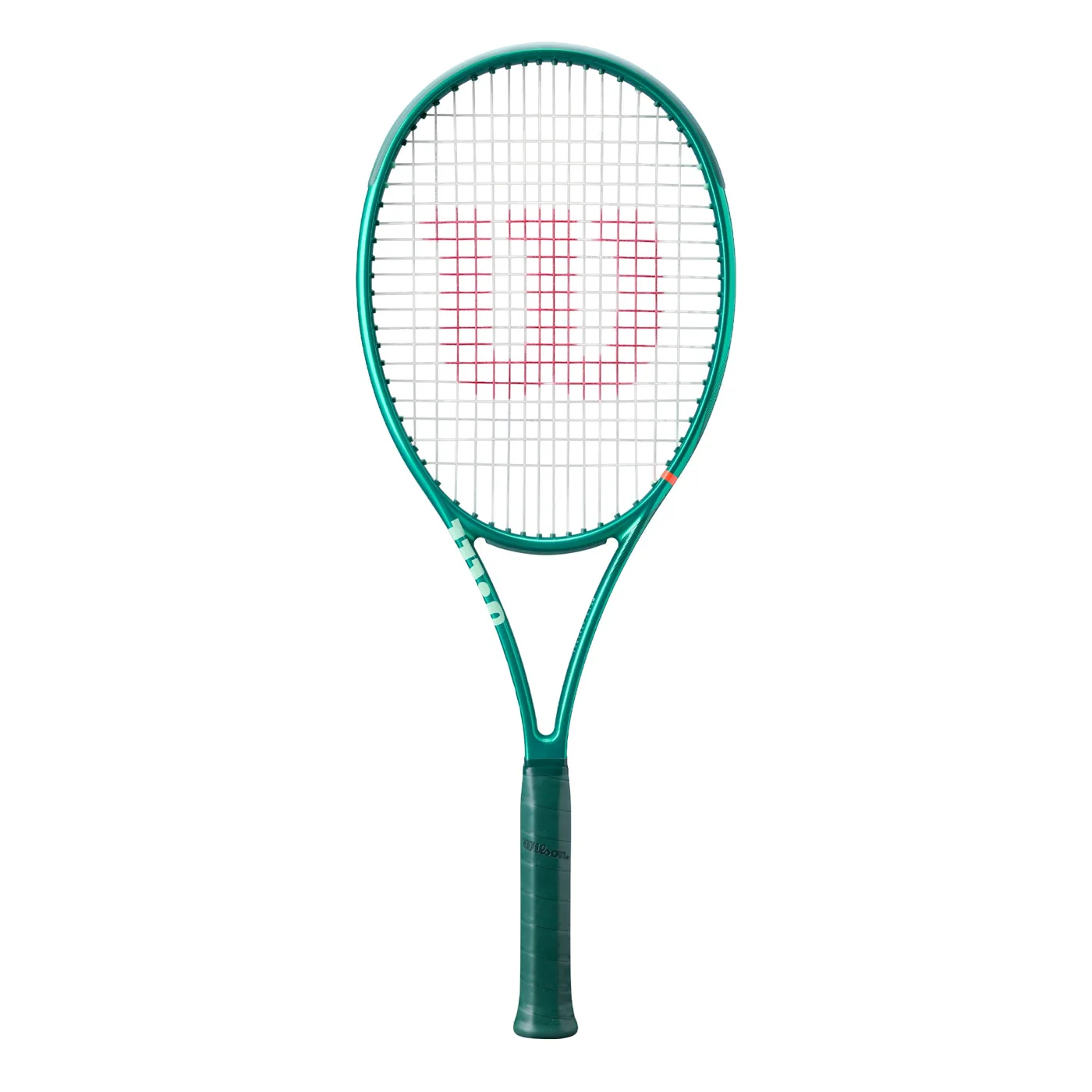
Racket
Wilson Blade 98 16x19 v10
The Blade that finally keeps up with modern club pace without ditching the feel that made the line famous.
Court Score
4/ 5
Would I tell a friend to demo this? Not an average of the axes.How we score.
- Powerfree depth
- 3
- Controlaim when swinging out
- 5
- Spinshape / dip
- 4
- Comfortarm-friendly sessions
- 4
- Valueworth street price
- 3
- Head size
- 98 in²
- Unstrung
- ~305 g
- Strung
- ~323 g
- Balance
- ~4 pts HL
- Swingweight
- ~322
- Stiffness
- RA 61
- Pattern
- 16×19
- Beam
- 21.5 / 21.5 / 20.5 mm
- Tension
- 47–57 lbs
What it is
Late in a third-set deuce, the ball jumping into your hip, and you still take a full cut — it leaves with dip and depth instead of floating long. That’s the Blade 98 16x19 v10 in one picture: Championship Green control DNA, now with a TurboTaper beam that thickens toward the hoop so the frame holds a line when pace gets rude.
Wilson’s standard player’s 98 for 2026 — 98 sq in, ~305 g unstrung, open 16×19 — not denser 18×20, not Blade 100, not Team/Lite. Sold unstrung; US street ~$299.
Who it’s for
Serious recreational and club players who already swing with intent (roughly 4.0+): baseliners who create pace, shape heavy topspin, and want the ball to go where they aim when they swing out. Strong fit if you live on a two-handed backhand and change direction down the line.
Skip it if you need free power from a 100+ head (Pure Drive / Ultra territory), if you’re still finding contact, or if you hit flat and want maximum low-launch precision — that’s the Blade 98 18×20 sibling.
Standout details
- Specs that matter: 98 in² · ~305 g unstrung / ~323 g strung · ~4 pts HL · SW ~322 (TW) · RA 61 (TW) · 16×19 · 47–57 lbs · beam ~21.5 / 21.5 / 20.5 mm
- TurboTaper beam: first real geometry shift in years — ~20.5 mm at the throat to ~21.5 mm at the top of the hoop for more plow and less wobble vs the constant box of older Blades
- StableFeel+: stiffer torsional response on off-center hits so you can stay aggressive when the ball jumps
- Classic Blade package: FORTYFIVE° layup, DirectConnect handle, Parallel Drilling, Click & Go bumper/grommets — braided graphite feel stays plush
- Open 16×19: higher launch and easier spin than the 18×20; the pattern most rec players should demo first
- Tradeoffs: you still supply the engine; beginners and power-seekers will find it demanding; $299 is premium, not a bargain-bin play
Who’s hitting it
Blade has been a tour workhorse since 2006. Wilson’s V10 push names Aryna Sabalenka, Amanda Anisimova, Mirra Andreeva, Vicky Mboko, and Emma Raducanu on the WTA side, plus Jakub Menšík, Hubert Hurkacz, Gabriel Diallo, and Ugo Humbert on the ATP — different games, same “press without panic” mindset. Tennis Warehouse’s athlete row on this specific 16×19 page highlights Hurkacz and Katie Boulter.
Retail ≠ tour setup. Pros customize weight, balance, and strings heavily. Sabalenka’s Blade story includes denser-pattern and custom frames historically; Wilson also sells a limited Saby Tiger cosmetic on this same 16×19 mold. You’re buying the spin-friendlier stock 16×19 that most club players should actually put in the bag. Why rec players care: the tour noise proves the platform can take violence; v10’s extra stability is what shows up in a Thursday night league match, not only on TV.
Honest verdict
If Court List already covers EZONE 98, Speed MP, and Pure Drive, Blade fills the “I generate pace and want it to land” slot. Demo the 98 16×19 v10 if you swing with intent and want a modern player’s frame that shapes spin without floating. It’s not free power and it’s not cheap — for serious recreational players who already hit through the ball, it’s the Blade worth owning in 2026.
Updated 2026-09-06